


CONTACTS
No.467 Changjiangzhong Road, Huangdao District, Qingdao City, China
22th Apr, 2026
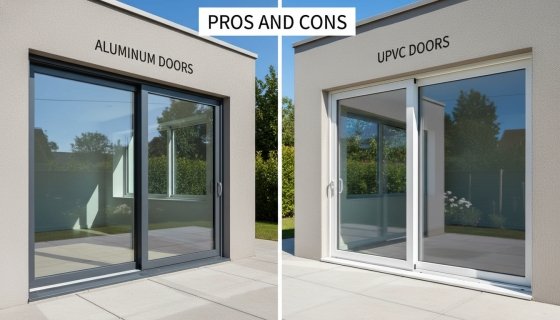
Doors define both the appearance and performance of a building. In 2026, aluminum and UPVC doors are two of the most popular choices for residential and commercial applications. Understanding their pros and cons helps architects, developers and contractors make the right decision for each project type.
The global windows and doors market is set to reach about USD 214.2 billion in 2026, driven by urbanization, renovation and higher efficiency standards.
Aluminum doors and windows are expected to represent a significant portion of this growth, valued at around USD 74.88 billion in 2026.
UPVC doors and windows continue to expand, forecast at roughly USD 44.26 billion in 2026, reflecting their popularity in residential segments.
Pros
Strength & large openings
Aluminum is strong yet lightweight, making it ideal for sliding, folding and French doors, as well as wide entrances and terrace walls.
Modern aesthetics
Slim profiles and narrow sightlines create contemporary, clean lines, popular in modern homes, offices and hospitality projects.
Durability & low maintenance
High‑quality powder coating or anodized finishes protect against corrosion and wear, resulting in minimal maintenance requirements.
Thermal performance (when needed)
Thermally broken aluminum systems significantly improve insulation compared to non‑broken profiles, aligning with 2026 energy codes.
Cons
Typically higher initial cost than UPVC, especially for large folding systems and custom configurations.
Without thermal break, aluminum can be prone to condensation and lower energy efficiency—important to specify correctly in cold or hot climates.
Pros
Cost effective
UPVC doors usually come at a lower initial cost, which suits high‑volume residential and mid‑range projects.
Good insulation & air tightness
Multi‑chamber profiles and effective weather sealing help achieve good thermal and acoustic performance.
Low maintenance
No painting or sealing; just occasional cleaning and hardware checks.
Corrosion resistance
Resists moisture and salt, making UPVC suitable for coastal and humid environments.
Cons
Frame sizes tend to be larger than aluminum for equivalent performance, reducing visible glass.
Design flexibility and color options, while improving, may still be more limited than aluminum for ultra‑modern aesthetics.
Aluminum doors
Main entrances, terrace doors, balcony sliders, bifolding doors for hotels, villas and commercial facades.
Projects where large glass surfaces and modern design are priorities.
UPVC doors
Residential entrance doors, back doors, balcony and terrace doors in apartments and houses.
Affordable housing, rental properties and renovation projects where cost and low maintenance are key.
Since 2015, Qingdao Honor Building Products has manufactured and exported both UPVC and aluminum door systems for international clients:
Aluminum door systems: casement, sliding and folding doors, including thermally broken profiles for better energy performance.
UPVC systems: a full range of casement and sliding windows, adaptable for door‑height elements and residential entry points. We work with:
Distributors & retailers – to supply stocked and custom door systems for local markets.
Contractors & developers – to meet project‑specific requirements in Germany, Cyprus, USA, Caribbean, South America and Asia. By sourcing both aluminum and UPVC doors from one partner, you benefit from:
Simplified procurement and logistics.
Consistent documentation and quality standards.
Technical support tailored to 2026 energy and building code requirements.
Factor | Aluminum Doors | UPVC Doors |
Cost | Mid‑range to high (especially for folding/thermal break) | Generally lower |
Strength & spans | Excellent; suitable for large openings and folding systems | Good for most residential sizes |
Insulation | Good with thermal break; careful specification needed | Good with multi‑chamber profiles |
Durability | Very durable with quality finish; corrosion‑resistant | Durable; resistant to rot and corrosion |
Maintenance | Low; mostly cleaning; inspect finish periodically | Very low; no painting |
Style | Slim profiles, modern look; ideal for contemporary design | Clean lines; slightly wider frames |
Weight | Lightweight but strong | Heavier than aluminum per comparable size |
Best for | Premium homes, hotels, offices, facades, large openings | Residential, rental, coastal, cost‑sensitive projects |
Q1: Are aluminum doors more secure than UPVC doors?
A: Both can be highly secure when specified with quality locking systems, multi‑point locks and toughened or laminated glass. The frame material alone does not determine security; hardware and installation are equally important.
Q2: Can UPVC doors be used in modern designs?
A: Yes. Modern UPVC profiles come in various finishes and can complement contemporary architecture. However, for very slim frames and large glass walls, aluminum is often preferred.
Q3: Do you supply both aluminum and UPVC doors from one factory?
A: Qingdao Honor Building Products offers both aluminum and UPVC systems, allowing you to combine different door types in one project while maintaining consistent quality and service.
Q4: Which is better for coastal projects—aluminum or UPVC doors?
A: Both can work well with proper specification. UPVC resists salt air and moisture, while high‑quality aluminum with marine‑grade coating and hardware also performs excellently. We can advise on the best configuration for your specific location.
Q5: What lead times can I expect for custom door orders?
A: Lead times depend on order size, configuration and destination. We work closely with partners to plan production and shipping, especially for large projects.

No.467 Changjiangzhong Road, Huangdao District, Qingdao City, China
